
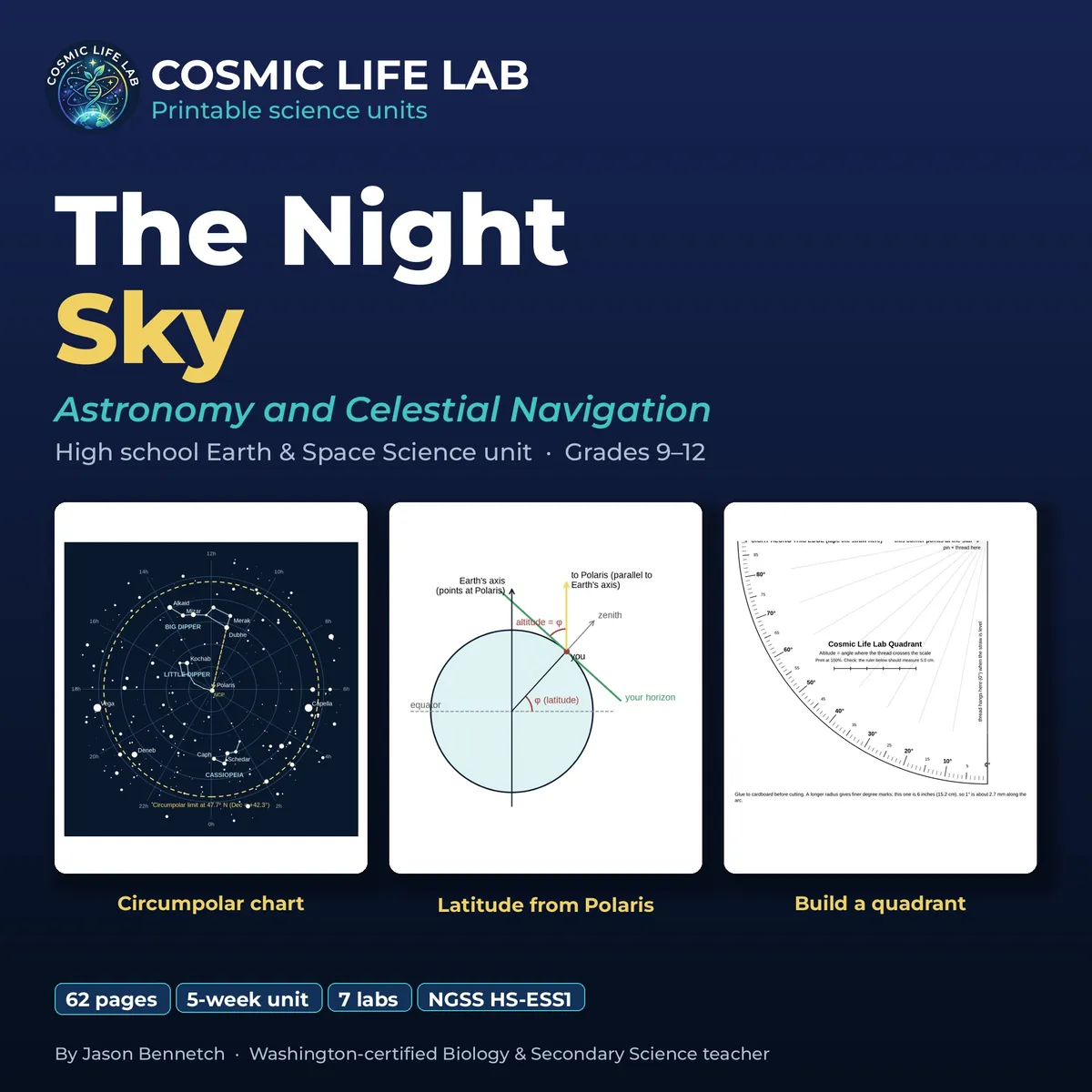
Cover of the grades 9–12 unit. A zoomed-out overview of all 62 pages is further down this page. The full 62-page PDF is delivered after purchase.
About this unit
Teach the night sky as both science and navigation. In this 62-page, 5-week printable unit for Earth & Space Science, students go from magnitudes, the celestial sphere, and light pollution to a featured week on navigating by the stars — latitude from Polaris, a build-and-use quadrant with an error budget, latitude from the noon Sun, the longitude problem, southern skies and Pacific wayfinding, and celestial navigation versus GPS — then on to the Moon and orbits, starlight and spectra, and evidence for the expanding universe. Every reading is paired with a chart, a lab, or a check for understanding, and students also read short excerpts of the real sources that built this knowledge.
Featured week: Navigating by the Stars
Week 2 (pages 18–31) is the heart of the unit. Students find north and latitude from Polaris, measure angles, print and build a quadrant at 100%, take a Polaris latitude with an error budget, find latitude from the noon Sun, work through the longitude problem, look at southern skies and a 32-house star compass, and compare celestial navigation with GPS. The week can also stand alone after a one-day primer on the celestial sphere.
Honors extension boxes mark items that go beyond a standard course. Color looks best for the charts; every page prints legibly in black and white. No physical item ships, and the unit does not include an editable slide deck or Word/Google files. Night observing is optional: every lab has a daytime or planetarium-software path.
Use it for about five weeks of 50-minute periods, or follow the tighter 3-week path in the pacing guide. It works for classrooms and homeschool. Readings can be assigned as homework if class time is short.
The primary standards matches are NGSS HS-ESS1-1, HS-ESS1-2, HS-ESS1-3, and HS-ESS1-4 (the life span of the Sun and fusion; evidence for the Big Bang; elements from stars; mathematical models of orbital motion). HS-PS4-1 is addressed through wavelength, frequency, and spectra. The featured navigation week also supports right-triangle trigonometry and quantitative accuracy (Common Core HSG-SRT.C.8 and HSN-Q.A.3).
Preview
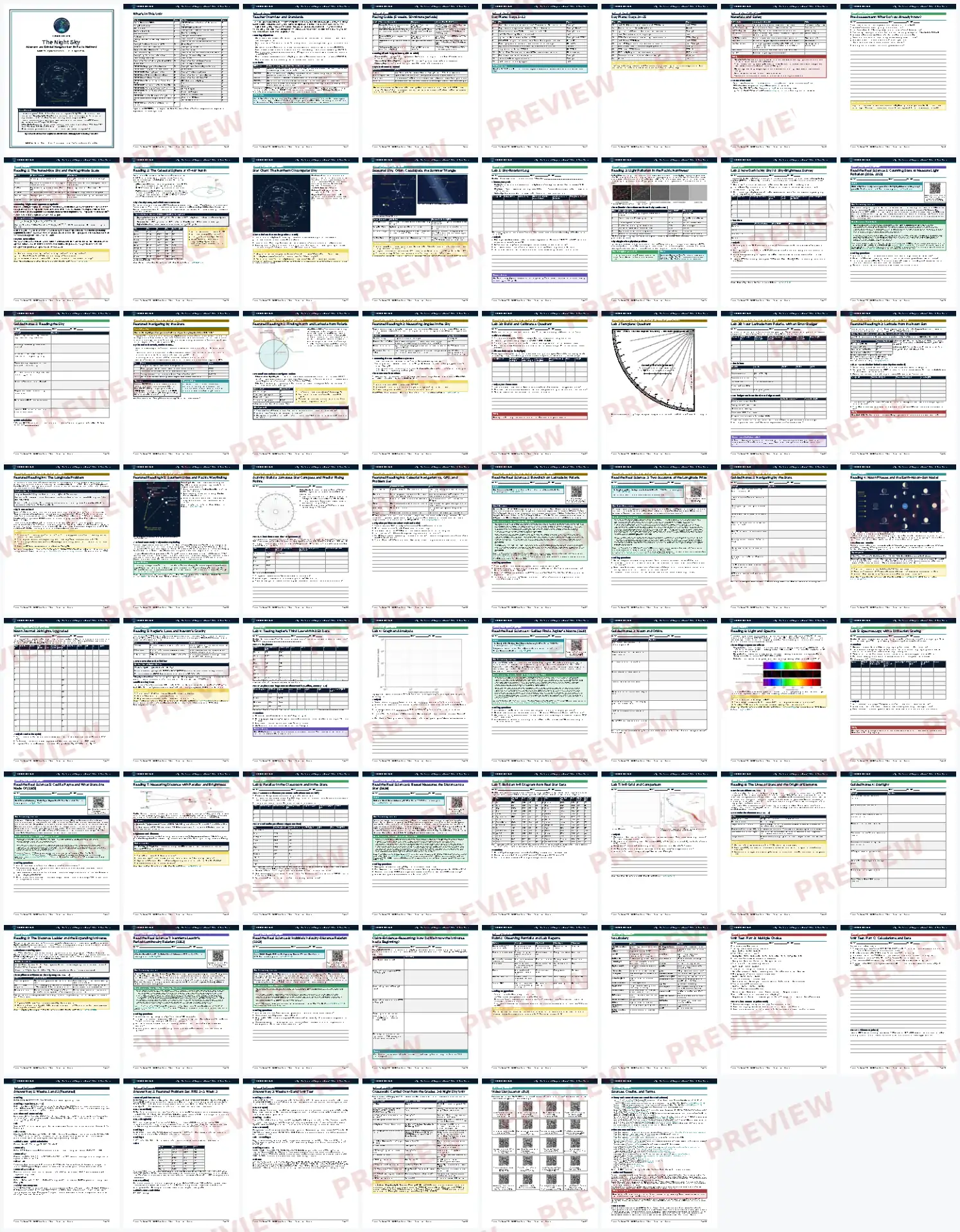
A short zoom across the same low-resolution overview. Text stays unreadable at the closest zoom. The full file is delivered after purchase.
Zoomed-out overview of all 62 pages (low resolution, watermarked). Text is not readable at this scale. The full file is delivered after purchase.
Terms of use
Original text, labs, worksheets, test and keys © 2026 Jason Bennetch / Cosmic Life Lab, licensed to one teacher for one classroom (or one family, for homeschool). Additional teachers or classrooms need additional licenses. Please do not post the original text, worksheets, test, or answer keys online.
Star data come from the HYG star database v4.4 by David Nash (astronexus), licensed CC BY-SA 4.0. The circumpolar chart, Southern Cross chart, H-R reference diagram, and HYG data tables are adaptations shared under CC BY-SA 4.0. The Orion and Summer Triangle charts, carried over from the grades 3–8 unit, remain under CC BY-SA 2.5. Those adapted images and tables may be copied and adapted if credit is kept and the same license is used. ShareAlike applies to those adapted images and tables only; it does not turn the original lesson text into a free worksheet pack. See the credits page in the file.
Created by Jason Bennetch, a Washington-certified teacher (Biology and Secondary Science). Preview images show actual pages from the unit.